Hudson heuristics
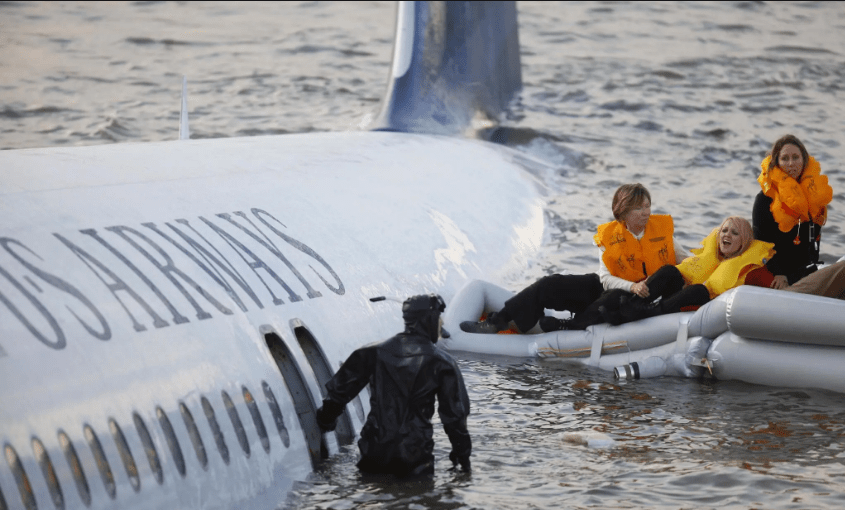
When it dawned on the passengers that they were gliding toward the ground , it grew quiet on the plane. No panic, only silent prayer. Captain Chesley Sullenberger called air traffic control: “Hit birds. We’ve lost thrust in both engines. We’re turning back towards LaGuardia.”
But landing short of the airport would have catastrophic consequences, for passengers, crew , and the people living below. The captain and the copilot had to make a good judgment. Could the plane actually make it to LaGuardia, or would they have to try something more risky, such as a water landing in the Hudson River? One might expect the pilots to have measured speed, wind, altitude, and distance and fed this information into a calculator. Instead, they simply used a rule of thumb:
Fix your gaze on the tower: If the tower rises in your windshield, you won’t make it.
No estimation of the trajectory of the gliding plane is necessary. No time is wasted. And the rule is immune to calculation errors. In the words of copilot Jeffrey Skiles: “It’s not so much a mathematical calculation as visual, in that when you are flying in an airplane, things that— a point that you can’t reach will actually rise in your windshield. A point that you are going to overfly will descend in your windshield.” This time the point they were trying to reach did not descend but rose. They went for the Hudson.
https://fs.blog/gerd-gigerenzer-risk-savvy/

 PeteStilgoe.com